Experience Laser Periodonal Treatment
Laser Periodontal Disease Treatments - Austin Laser Dentist
How Periodontal Disease is Treated
Dr. Ragsdale incorporates the newest technologies and techniques (laser periodontal treatment) to bring state-of-the-art care to her patients and believes that patient comfort is an essential part of quality dental care.
The results of "cleaning and disinfecting" together have been shown to be much more effective than either one alone. Root Planing and Scaling is one of the best approaches for giving the body a fresh start at healing the gum and bone around the teeth. Dr. Ragsdale allows you to reach periodontal health in a simple, effective, less invasive, and more affordable way.
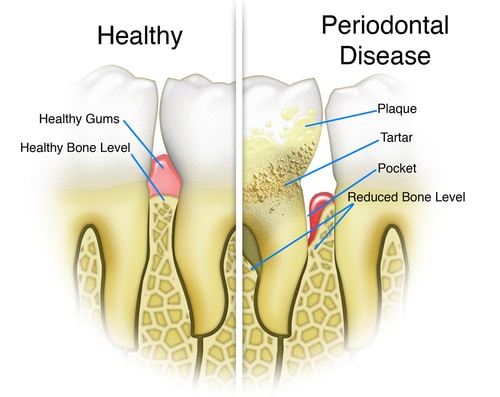
Some of the Ways Periodontal Disease is Treated:
The signs of periodontal disease are
excess plaque,
tarter buildup,
pockets,
and bone recession.
Laser Gum Surgery
LASER PERIODONTAL THERAPY is an amazing breakthrough in periodontal treatments. It’s no longer necessary for scalpel and suture gum surgery due to this new laser alternative. A tiny laser fiber (about the thickness of three hairs) is inserted between the tooth and the gum and the infection is cleared away.
<h3>Root Planing and ScalingRoot Planing and Scaling
We emphasize conservative periodontal therapy. Many times, early stages of periodontal disease are best treated with nonsurgical periodontal therapy. The first step is usually a thorough cleaning where plaque and tartar from above and below the gum line are scraped away (scaling) and rough spots on the tooth root are made smooth (planing). Four to six weeks later, periodontal pockets are eliminated due to gum shrinkage. Then the patient can personally maintain these areas with routine brushing and flossing.
Laser Pocket Decontamination
Advances in dental laser technology can treat periodontitis and sometimes avoid surgery. The precise dental lasers we use emit a focused beam that eliminates bacteria in the periodontal pockets (called laser decontamination). After removing plaque and deposits, the thin laser probe is lowered into the bottom of the bacteria-infected periodontal pocket. The laser beam removes aggressive bacteria (germs) and creates conditions that aid the healing of periodontal infections. Clinical studies show that laser therapy considerably improves the chance of recovery from periodontal disease.
Gum Grafts - Subepithelial connective tissue grafts
When recession of the gingiva occurs, the body loses a natural defense against both bacterial penetration and trauma. Gum recession also often results in root sensitivity to hot and cold foods as well as an unsightly appearance to the gum and tooth. Also, significant gum recession can lead to the exposure of the root surface, which is softer than enamel, and cause root caries and root gouging. A gingival graft is designed to solve these problems. The gingival graft procedure is highly predictable and results in a stable healthy band of attached tissue around the tooth.
Guided Tissue Regeneration
This surgical procedure "regenerates" the previously lost gum and bone tissue. Most techniques utilize membranes, which are inserted over the bone defects. Some of these membranes are bio-absorbable and some require removal. Other regenerative procedures involve the use of bioactive gels and agents.
Bone Grafting
Over time, the jawbone associated with missing teeth atrophies or reabsorbs. We now have the ability to grow bone where needed. This not only gives us the opportunity to place implants of proper length and width, it also gives us a chance to restore functionality and esthetic appearance. The bone graft procedures are:
- Sinus lift procedure - The sinus membrane is elevated and bone graft is placed onto the sinus floor, allowing implants to be placed in the back part of the upper jaw.
- Ridge-augmentation -
In severe cases, the ridge has been reabsorbed and a bone graft is placed to increase the ridge height and/or width.
Once my gums have been treated, is the Periodontal Disease gone?
Unfortunately, this is not usually the case. Periodontal disease is a chronic condition that is not cured but it can be stabilized and maintained. Once the initial treatment has been completed, regular maintenance care is essential to keep the disease under control and to maintain good oral health.
Why is maintenance so important?
Periodontal disease often follows certain patterns. Pockets and bone loss usually begin in the upper molars, followed by the lower molars, and in time, it will involve other teeth, as well. Once formed, periodontal pockets do not get worse on a daily basis. Rather, pockets can remain stagnant for a long period, only to have short bursts of problems when they worsen, only to become stabilized again. Along the way, abscesses can occur, and pockets and bone loss can progress to the point that teeth need to be removed. Regular maintenance and treatment will delay this process and, in many instances, will even stop this progressive gum/bone deterioration.
Periodonal Disease Before and After Pictures
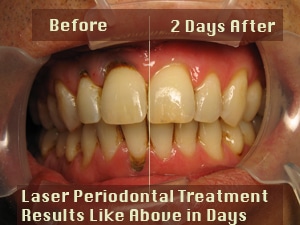
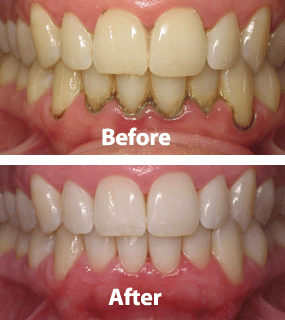
Periodontal disease before and after image 1 shows the results of root planing and scaling, laser pocket decontamination, and teeth whitening
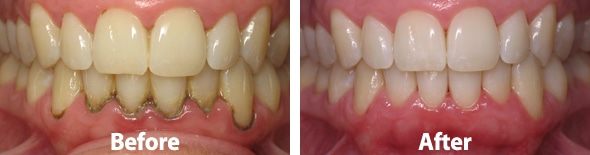
Periodontal disease before and after image 2 shows the results of root planing and scaling, laser pocket decontamination
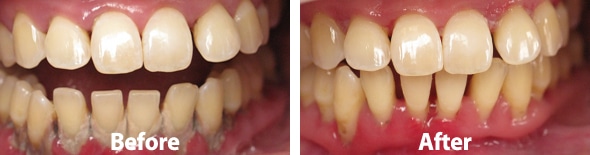
Periodontal disease before and after image 3 shows the results of root planing and scaling, laser pocket decontamination where one side was treated and the other left alone to show how quick and effective laser periodontal treatment can be.